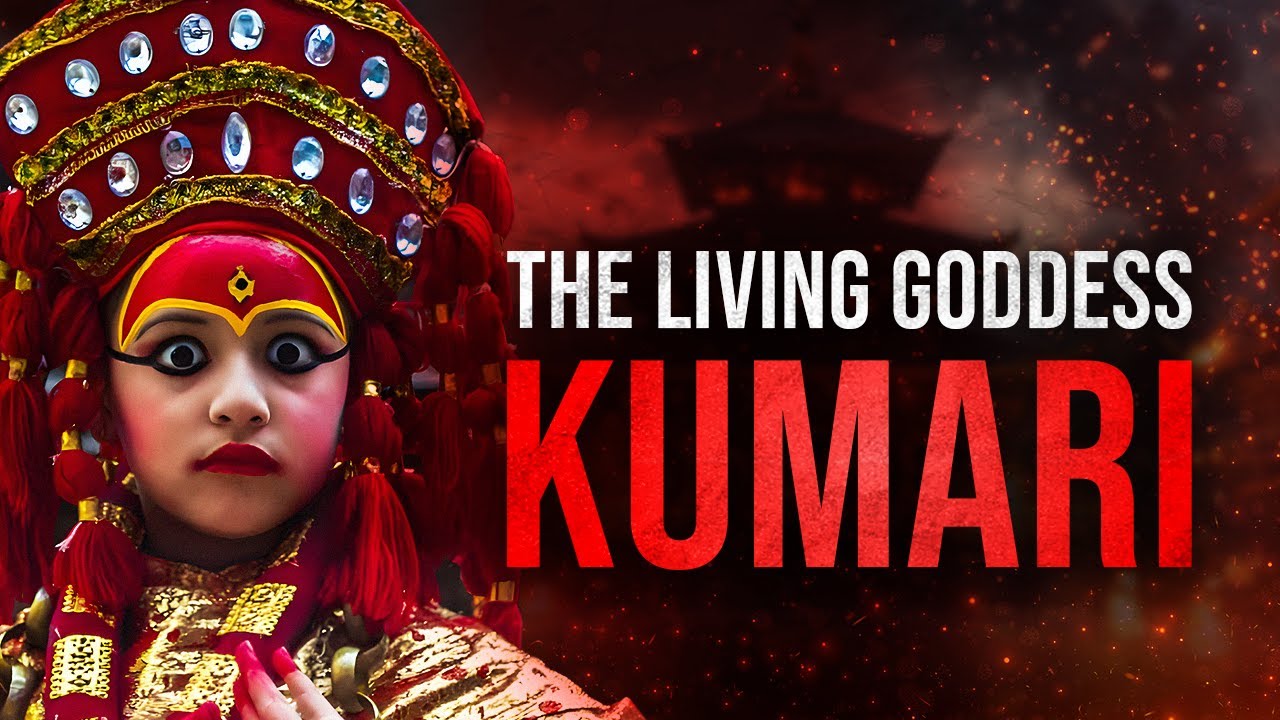
Kumari
The Living Goddess
In the heart of Kathmandu's ancient Durbar Square stands a three-storey palace of carved wood and stone. Inside lives a child - not yet ten years old - whom millions of Hindus and Buddhists alike worship as a living goddess. She does not teach, preach, or perform miracles. She simply appears, briefly, at an ornately carved wooden window on the third floor, and looks down at the crowd gathered below. That look - that single, wordless act of seeing - is itself the blessing. This is the Kumari. This project is an attempt to understand what it means, theologically and academically, that a girl becomes a goddess in twenty-first century Nepal - and what it reveals about sacred power, gender, and the living, breathing practice of a religious tradition that refuses to stay in the past.
Journey through the sacred architecture of the tradition.
Who is Kumari?
An introduction to Nepal's living goddess - the tradition, the Kumari Ghar palace, and the girl behind the third eye.
Devi in Human Form
How the Kumari embodies Shakti and the goddess Taleju - a manifestation of Durga from the Devi Mahatmya tradition.
The Art of Darshan
What happens when thousands gather beneath a window? The sacred politics of seeing and being seen during Indra Jatra.
Becoming the Goddess
The 32 attributes, the Kalratri fearlessness test, and the elaborate selection rituals - corrected by a former Kumari herself.
When the Goddess Leaves
Menstruation, transition, and the emotional weight of returning to ordinary life after years as a deity.
Tradition in the Modern World
The 2005 Supreme Court case, Nepal's distinctive secularism, and why even Maoists saluted the Living Goddess.
"What does the Kumari tradition reveal about how Hindu theological concepts - specifically Shakti, darshan, and ritual purity - operate as living, embodied practice rather than abstract doctrine? And what does the tradition's treatment of menstruation as the end of divinity tell us about the intersection of gender ideology and sacred power in the Kathmandu Valley?"
The Kumari tradition is not a relic or a cultural curiosity but a living theological argument: that the divine feminine power described in texts like the Devi Mahatmya is institutionally enacted in Nepal through the selection, seclusion, and eventual dismissal of a prepubescent girl as a living vessel of the goddess Taleju Bhawani. The tradition's most revealing feature, however, is not its beginning but its end. The moment menstruation terminates a Kumari's reign makes visible the patriarchal logic embedded even within goddess-centered worship: that female bodies are sacred only insofar as they remain unambiguously pre-adult and "pure." The Kumari simultaneously elevates and circumscribes the divine feminine in ways that both challenge and reproduce broader gender hierarchies in South Asian religious life.
A Goddess Who Walks Among Us
This project set out to answer two questions. The first: how do Shakti, darshan, and ritual purity operate as living, embodied practice rather than abstract doctrine? The answer, across six chapters, is this: they operate through a child who lives in a palace and looks out a window. Shakti is not a concept taught at the Kumari Ghar; it is housed there, present in a specific body, made visible through a specific gaze. Darshan is not a theological category in Nepal; it is a crowd pressing into a courtyard, a head of state kneeling to receive a red mark on his forehead. Ritual purity is not a textual principle; it is a medical history documented before a girl is three years old. These concepts are alive because they are structural: they determine who the goddess is, how she is encountered, and when she is gone. Their political durability, surviving Malla kings, Shah dynasties, Rana autocracy, and a Maoist republic, is itself the evidence.
The second question: what does the tradition's treatment of menstruation as the end of divinity reveal about the intersection of gender ideology and sacred power? The answer is precise, if uncomfortable. The same ritual purity logic that selects the Kumari, a body that has never shed blood, never been opened, perfectly intact, is the logic that dismisses her. Selection and dismissal are two applications of one rule. And that rule reveals the limit the tradition places on its own most radical claim: the Devi Mahatmya declares the goddess dwells in all beings, yet the Kumari institution can only house her in a pre-pubescent body. The patriarchal logic is not imported from outside the tradition. It is the tradition's own internal hinge, the point at which a theology of universal feminine power becomes a practice of controlled, bounded, and temporary feminine power.
For me, as someone from Nepal, this project has been an act of seeing something familiar with new eyes. The Kumari is not a relic. She is living proof that theological claims are not preserved in manuscripts; they are enacted in real girls' bodies, in a real palace, in a city I grew up in. She is a child. She is a goddess. She is both. And the fact that she cannot be both for more than a few years is the most honest thing the tradition says about itself.